


Over the last few years on Brainwaves it has been our pleasure to cover the Zenobia Award. The award, and accompanying mentorship programme, is intended to open up the world of historical wargaming to a more diverse designer group. It has created some wonderful games covering everything from Mayan Agriculture to avoiding the police as queer folk in 18th century England (the forthcoming Molly House from Wherlegig Games).
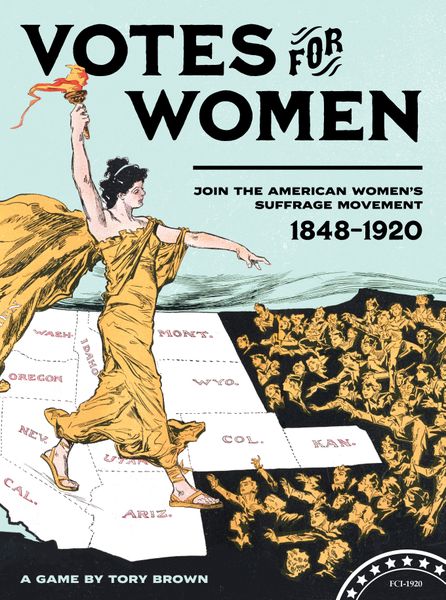
The game I am covering today was not part of the award but it feels like the sort of title a more diverse hobby makes room for. Votes for Women is designed by Tory Brown and published by Fort Circle Games. The art and graphic designs is by Brigitte Indelico and Marc Rodrigo (II). It sees players battling over the pivotal political movement that gave women the right to vote and the subsequent vote on the legislation, the 19th amendment, in the United States of America.
Players take on the role of either the Suffragette movement or “The Opposition”. Through the use of cards each side will spread their political influence from east to east coast. They will clash over states as they manipulate the favour of the people. Eventually the political manoeuvring will move to the halls of congress as both sides try to get their will stamped into history.


Those familiar with card driven games like Twilight Struggle will find themselves very much at home. The cards in Votes for Women have an event on them and can be played simply to make that happen. Alternatively they can be spent to activate certain actions allowing you to manipulate your presence on the board. The events on the cards take you through some of the pivotal people and moments of the suffragette movement. Each comes with a snippet of the history and certainly led to me looking up some things online. Although the events are powerful, you will not always want to use them for that particular ability. Instead you can spend them as a resource to campaign, organise, or lobby.
Campaigning gives you a chance to move your campaigners between regions and put down some of your cubes to represent how much that region is persuaded by your side of the argument. Each region has 8 states, and where you choose to pick your battles, or cut your losses, is a vital part of the strategy in Votes for Women. This action does introduce an element of randomness, as you roll dice to see how much you can manipulate that particular area of America. Only one side can have influence in a particular state. If you want to put your own cubes down where the other side currently holds sway, you have to remove cubes first before putting down your own.
Organising gets you a resource called Buttons, represented by huge cardboard tokens that look like campaign badges for either side. These buttons can be spent to re-roll dice, move campaigners during the campaigning action, or power various abilities on cards. Finally you can lobby, pushing congress towards the final vote at a time that suits your agenda.
The game plays out over 6 rounds with each round having 6 actions a side. Initially it feels like ‘The Opposition’ player has the upper hand, which they do, and did historically speaking. As the game ticks on the sides draw level, card powers increase, and the Suffragettes feel like they are gaining momentum.
As the sides push and pull the will of the populace, battle is met across the states and regions of the United States. You have a constant back and forth to contend with that mostly feels like a tight contest. It can occasionally feel like you are spending actions to simply undo what your opponent just did, but clever card play often gets around the problem more efficiently. Although the action choices are simple, you can pull those levers in a variety of interesting ways to gain the upper hand.
The early game is given some direction by the state cards that you can win as bonuses. These cards are chosen randomly at the start of the game and give an extra playable card to the side that takes the state on the card to 4 of their cubes first. They can provide powerful effects and really swing the momentum as they can be played in addition to the action you take on your turn. It feels vital to battle over these early on, and certainly in a couple of games I ignored them to my detriment.
On top of the states cards, and the battle for the votes across the country, you also are offered some strategy cards to grab after the first turn. This is done through an auction for buttons at the start of the turn and can prove an excellent way to drain your opponents resources, or grab a card that will give you an edge in a future action. These little bidding wars feel like a piece of grand strategy, as you eye up where each card you could potentially get could be useful, and how they fit into your overall plan. Of course you could just be trying to drain your opponent of resources.
Ultimately though both sides are trying to get to the position where they can dominate the vote in congress. This will always happen in the game as the 19th amendment is brought before that institution for ratification or rejection. Lobbying allows you to hurry this along if you find yourself in a strong position, but at the end of the 6th round it will happen regardless.
When it occurs you look at the political map of the states you have created. Any state with 4 or more cubes is going to vote for that side. Anything below that and it comes down to a dice roll, with all the risks that entails. Due to the way that ratifying constitutional amendments works, the suffragette player requires three quarters of all states to swing their direction. With 48 states at this particular moment in history, the suffragette player needs 36 states to win, while ‘The Opposition’ need only 13 to block the bill’s passage.

When the vote begins each side locks out states with 4 or more cubes of their colour. This is represented by the placing of huge wooden ticks or crosses on the states that are for or against the 19th amendment. There is a real ceremony when you do this, and the noise they make as they are placed echoes in your ears, resounding with victory and defeat. The crosses especially just feel horrible for the suffragette player as so few are needed to bring your dreams crashing down.
If the vote happens at the end of the game, you simply roll off the remaining states that aren’t locked down. Buttons can be used to re-roll these and you get a bonus based on the number of cubes you have in a state. Although it can be a slightly long process doing this, it feels full of tension and interesting choices right to the end. With limited resources you have to choose where to fight your battles and where to hold up your hands and cut your losses. It has never failed to feel tense to me, and often comes right down to the wire.
If the vote happens part way through the game the game continues on. States are locked down as they get to 4 cubes of either sides colour, allowing you to get an easier sense of where to place your precious resources to come out on top. When it happens this way there is a real feeling of a chess clock running yout out of time. You push back and forth trying to weedle a state here or dominate a region there.
The production of Votes for Women is truly excellent. A simple bold map, with clear cards that carry snippets of historical information on them and clearly laid out abilities. A historical overview of the period is provided in the game alongside some lovingly recreated documents, flyers, and pamphlets from both sides of the struggle. The wooden cubes and campaigners are easy to pick up and place, and there are even extras provided should you lose some! I haven’t had a chance to play them but there is also a solo mode and modes for 3 or 4 players as well. I do think however that the two player game is likely where most people will experience a title like this.
For what is effectively a historical wargame the rulebook is excellent. Too often with these kind of games the rulebooks make for a great reference guide, but do a rubbish job of teaching you the game. Votes for Women manages to do both making it a breeze to setup and learn the game relatively quickly.
My only slight complaint would be that it would have been nice to have some player aides. Considering how many pamphlets, and other documents have been recreated for the product, with no impact on the game, it would have been nice to have some summary sheets reminding players of the various actions they can take on their turn. Seriously publishers, player aides will make sure your game is played more. Read my article here about why I think this is the case.
The edition I have also has no summary of the abbreviations for each of the states, making it a little tricky for those not familiar, like me, to exactly pin down where a card is referring to all the time. I believe this has been rectified in the current edition of the game that Fort Circle Games are putting out.

Votes for Women is an excellent game, and I think it would be a great introduction to world of card driven wargames. It does a fantastic job of not only being an entertaining game, but also of being a decent educational tool. I am sure that this game could be used in the classroom to give pupils a feel for what it is like to run a political campaign and the often difficult choices that folk must make to win for their side. All the information the cards had me frequently reaching for my phone to find out more.
Although the Suffragettes won out in the end, Votes for Women does not baulk at looking at the less savoury aspects of the movement. It was often a cause for white women, and certain segments of the suffragette movement believed in Votes for Women (unless you were black). The Opposition, who literally start with a card called ‘The Patriarchy’, feel grubby to play, and I really like that. I have won as ‘The Opposition’. While I revelled in my victory, it also made me feel bad that I had propelled a terrible organisation to a win. The game makes clear the political affiliations of its designer, without biasing the mechanisms towards the side that won in history. Well, any more than the simulation requires.
Whichever side you play you feel the weight of each card played. Events can represent a political compromise you don’t want to take, but you know will be good for ‘the cause’. Sometimes they are out and out just good, but as the game progresses the political decisions way heavily on you as you scramble for the a cube here and vote there to propel you to the finish line with your head just above water. Votes for Women is a shrewd piece of design from Tory Brown and a wonderful production from Fort Circle Games. It represents a bold declaration that ‘wargames’ don’t need to fire a single shot to be great.
I received Votes for Women from Fort Circle Games in return for a fair and honest review. A few months after receiving the game Kevin Bertram, head of Fort Circle Games, became a Patron of The Giant Brain and still is. I had already played a couple of games by then and decided to finish working on the game for review.
Thanks very much for visiting the site and reading this article. You are welcome to comment on the piece below or join our Discord. If you would like to support us financially you can do so via Patreon.

