


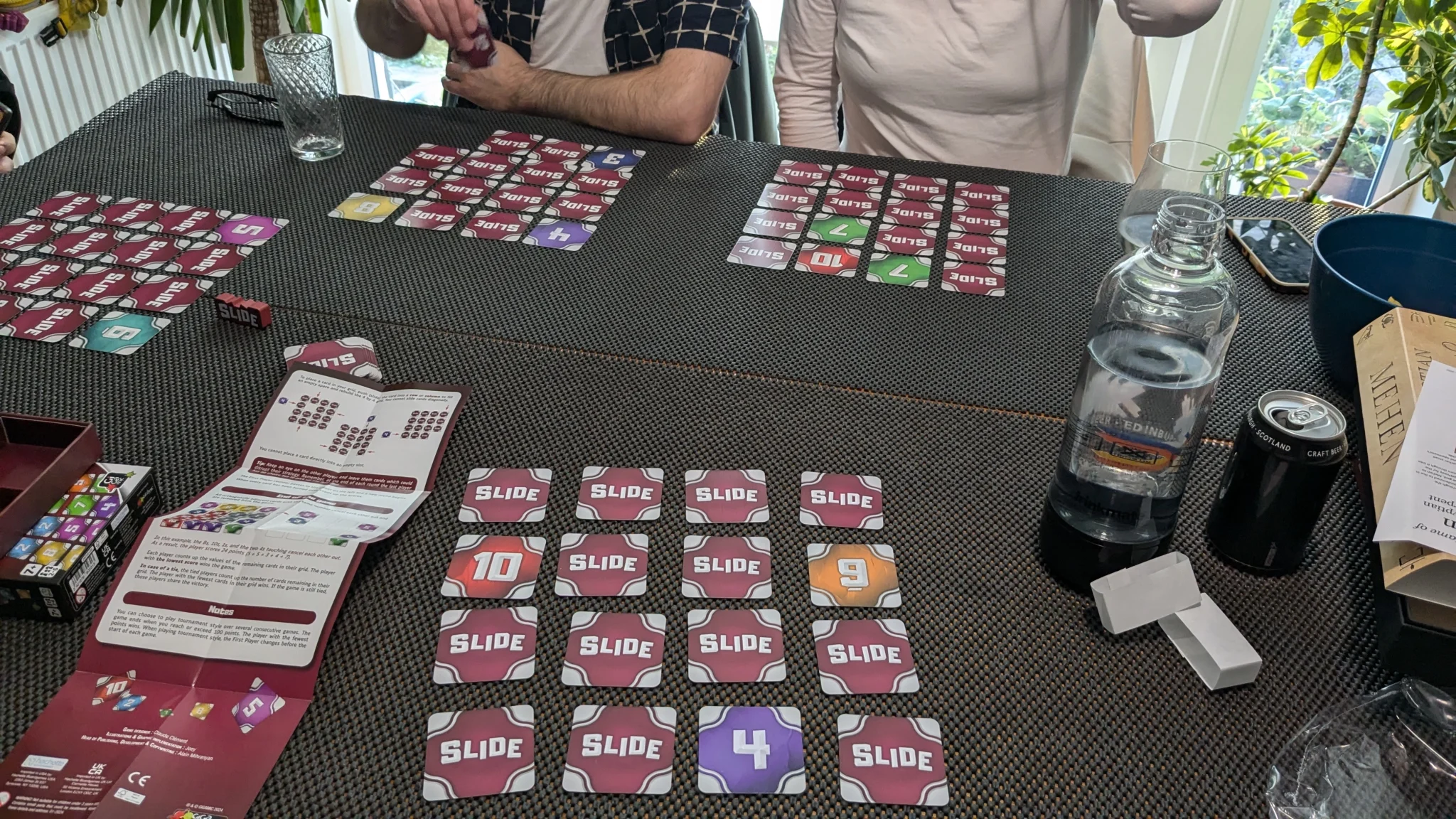
I have fond memories of trips with my family when I was a kid. Sat in the backseat with my brother, there would be a singing kettle playing from the tape deck, google it, and toys and puzzles in hand. The sliding puzzles that made a picture were a common toy that I recall vividly. Slide, from designer Claude Clement, artist Joey, and publisher Gigamic, evokes the feeling of those puzzles with a picture made from your own hubris.


Coming in a neat small box, Slide consists of a bunch of square cards and a first player marker. The cards are slightly annoying to shuffle because of their size and shape but the quality is good.
Each player gets 16 of these cards and lays them out in a 4 x 4 grid, face down, without looking at them. On a turn everyone will choose a card from their grid and turn it over, placing it in the middle of the table. Starting with the first player you will pick up one of those cards. You then slide it back into the grid, pushing cards along a row or column as required to return your grid to its 4×4 status.
This sounds incredibly random, and it is. At least at first. The goal though gives this randomness direction. It orders the chaos. When we have all the cards revealed, some 16 turns later, we score. First we discard all cards of the same number that are orthogonally adjacent to each other. Contiguous blocks of your grid vanish like you’ve completed a Tetris line. Any cards remaining are your score, lowest amount wins.


Yes we start randomly. There might be some logic to starting on the outside, but I am willing to be corrected by those more in the know. As your grid starts to fill up, you seek out numbers you need from the selection. You start to realise that depending on your place in the turn, card choices become safe or filled with risk. Different player counts change this calculation as you get to go first more or less as numbers fall and rise. I haven’t played with the maximum player count of 6 as yet, but for 4 and 3 players you get plenty of opporunity to steer the direction of a round. There are enough cards in the game that even at 6 players, you can’t entirely know the probability of any one card coming out.
There is theatre in that moment of flipping cards over. It may be effectively a random selection, but you can still blame everyone, including yourself, for not giving you the cards you need. It is a moment of mixed group emotion. Some get what they need, others have the joy of tough choices between bad options. The last in the round is relegated to picking up the scraps. Then the buck is passed. You got to wait for the wheel.
Your choice of card is not only affected by your grid, but those of the others around you. Yes you could take the card you need, but do you hurt someone else by taking a less optimal path? The decisions are simple, but flavoured with delicious opportunism.
When I was playing this I described it as a great caravan game. By that I meant the sort of thing you can play on holiday on a small table. It travels easily, is a light game, but has elements that get your brain working. It can be mean, surprising, and funny. I hope you’ll consider it for your next trip, wherever that may be.
A copy of Slide was provided by Hachette Boardgames UK.
Thanks very much for visiting the site and reading this article. You are welcome to comment on the piece below or join our Discord. If you would like to support us financially you can do so via Patreon.

