


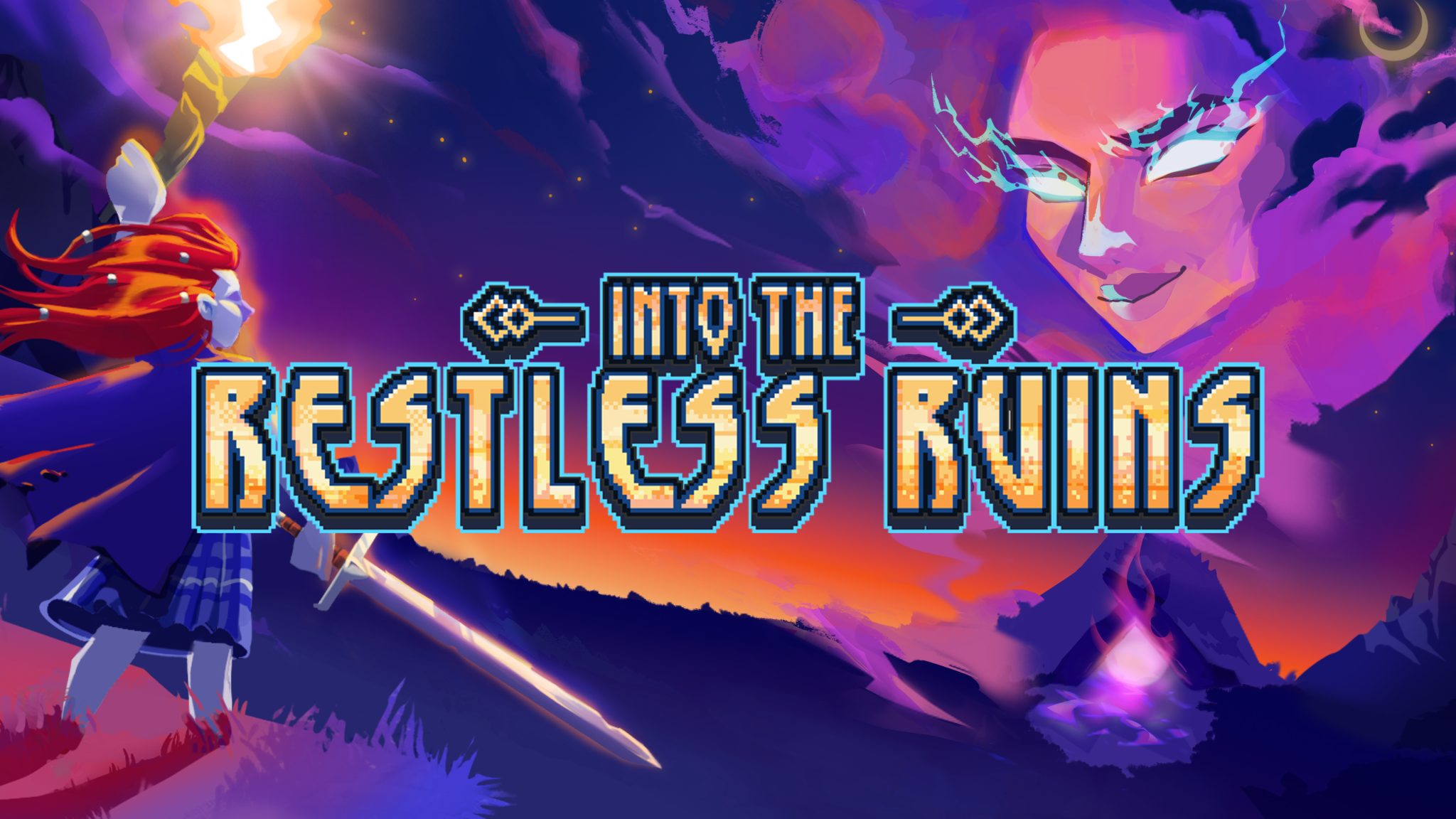
As with many cultural expressions, the world of games is not immune to trends. Physical and digital expressions of games can find themselves walking the line of the current mechanism-du-jour or technological innovation. Sometimes this is done as a safe bet, a hope of guaranteed return on investment. For others the primary motivation is to experiment with this new material. They want to take it and mould it into something new and exciting. These are sliding scales of profit and innovation, and when it really clicks both can be turned up to 11. Into the Restless Ruins, from publisher Wales Interactive, turns the innovation slide up to max, challenging you with building a dungeon, auto combat, and deck building. It’s an interesting combination of mechanisms that doesn’t quite come together into a satisfying whole.
I was sent Into the Restless Ruins for review. I played the game on Switch, exclusively handheld. Images are provided by the publisher.
Runs start with you drawing cards from your deck. Each card represents a piece of a dungeon. It could be a simple corridor, a place to rest and gain health, or an armory to get stronger. There are a wide variety of weird places you might end up building into your underground realm. When you play these cards, they become tiles, and you can rotate them to slot into your dungeon. The map is split into sections, their borders defined by a magical barrier. Your goal is to break through these barriers, opening up the map. Eventually finding your way to the boss chamber to bring them down.


The cards represent rooms, but each room is not just stone and doors. Each one placed can give passive bonuses helping you in the Harvest. See you aren’t only building a dungeon, you have to navigate it as well. Each ‘night’ you build first with a pool of points, then you venture into the dungeon in the Harvest.
Manoeuvring your way through your map your character auto attacks monsters they come across. You wind your way towards foggy rooms that are part of the map when you start. You are hoping to find the next seal to break down the barriers that split the map up. When you do, activating the seal gets you attacked by a horde of monsters you have to get past.
Your time in the Harvest is dictated by how much light you have. As the torch burns out, the circle of illumination around your character fades. It becomes harder to see threats and navigate your creation. It is your dungeon, but there is no map feature to look at when you are in the Harvest. Memory is the only guide, and it is a fickle beast. Wrong corners can be taken, dead ends encountered, and sighs of relief as you praise past you for a moment of sanctuary. If you run out of light, the circle is only just bigger than your character. Now your health ticks down instead. You have to get back out the same way you came in, without succumbing to exhaustion.
As the dungeon expands and your route gets longer, how do you deal with light? I mentioned that rooms provide bonuses, and it is here you can get more light, more health, better attack, and more. These passive bonuses are very useful, but many rooms will also have a trigger you can activate during the Harvest. These can top up your torch, replenish health, or give you more build points for the Night portion of the game. Dotting these resources around the map to keep you going, is vital to doing well in the game.

Of course this being a deckbuilding rogue-like means there are a lot of things to discover. I’ll try not to be too heavy on the spoilers, as I believe one of the joys of games is discovery. As you fight during the Harvest, you gain favour (basically experience points). When your favour bar fills you get to choose a new card to add to your deck of dungeon pieces. Options start to open up as stables increase your movement, or an Oubliette allows you to get rid of a card during the Harvest. You’ll encounter strange entities that will give you cards that buff your attempts, upgrade tiles, or thin your deck out. All these characters take Reics as payment, a resource you can find scattered throughout your dungeon.
Now you may be thinking ‘Can’t I just do short harvests and carefully build a dungeon?’. You could, but a timer puts pressure on you. Every night the skull bar at the top of the screen increases. When it fills completely your run is over. Every now and then it will also add a curse card to your hand. This increases the pace of the skull track filling, unless played, negatively affecting the next Harvest you do. Finding and unlocking seals can push the track back down and I am sure you might find other ways to stave off a loss. Dying in the dungeon comes with a substantial skull track increase, but it doesn’t end your run.
As you play, you’ll unlock new cards, larger maps, and cantrips. The latter give you modifiers, making your runs easier and harder, multiplying your score appropriately as you adjust the difficulty. With no map to aid memory, I found that making a path you can easily navigate becomes core to the experience. However there is always the siren call of a cool piece of dungeon that doesn’t quite fit, but has benefits. The game lures you into these traps like a gleeful dungeon master.

Much as I’ve enjoyed the dungeon building of Into the Restless Ruins, I became frustrated with the deck building aspect and unengaged by the core game loop.
Your favour builds up very fast at first meaning that you are getting assaulted with new card choices far too quickly on your initial Harvests. Every time you have to choose a card the Harvest goes into a sort of slo-mo then pauses, interrupting the flow of that part of the game. When you get going again it can be a moment of frustration as you get hit by monsters that were in pursuit and have to scramble out. There is no choice here, you always accumulate favour, and it is impossible to avoid as the monsters just keep coming.
The consequence of these too frequent card choices means you start to dismiss them more than you accept them. One of the cores of deck-building is to keep your deck consistent, doing the thing you want it to do. This means either increasing the frequency of the cards that you want to see, or getting rid of cards that you don’t fancy using.
When it comes to adding a card to your deck, that choice should feel loaded with consequences: do I take my deck this direction or that, will this card work better than that, this edge case card is cool but will it work? Here you are getting 3 cards to choose from at a pace that feels relentless. It is possible to tick over two favour fills at once giving you two lots of cards to choose from in a row! I started to find having to add cards more of an annoyance than a moment of joy, dismissing more than I took to keep my deck working how I wanted.
The other aspect deck building should bring to a game is synergy. Cards should work with each other, allowing you to feel moments of brilliance as you pull of a well timed combo. Now I have not seen every card in the game, I’ve got access to just about half of the possible cards you can get. Now that includes some of the bonus cards that aren’t dungeon pieces, and upgraded versions that I have seen. That is 53 out of 116 the game says exists. There are 23 dungeon cards I have seen that I have not upgraded as yet, so that is 76 out of 116. It also doesn’t include cards I have seen, but not chosen to take (best I can tell).

Only 1 of the cards, and it isn’t counted in the glossary I can look at because I haven’t chosen it, has an actual synergy with another card. The Farmland, I think that is what it is called, gives you more health for every Corridor you have in hand. Even when played into the dungeon it doesn’t feel like the rooms have much in the way of build synergy. None of the basic cards you start with come with any interaction with another card. As someone who loves card games, and has played a load of them, they just don’t feel like cards. Cards should have mystery and synergy, you deck should be manipulable and a source of potential. The cards just feel like a convenient way to express the dungeon tiles, and no more than that.
The early maps are pretty short affairs, which feels like where the game is at its best. As you unlock levels, maps get bigger. I’ve played up to the fourth map out of seven. I’ve seen a map that goes back and forth length ways as you crack open seals, and an enormous round arena where you are sort of spiralling towards the centre. I admit this is where I parted ways with Into the Restless Ruins. The runs just started to feel too long, and I was getting frustrated with the cycle of play. The building didn’t engage me, the Harvests felt too chaotic, and no matter how careful I was I seemed to get overwhelmed by random hordes.
I’d like to take a moment to aim some general criticism at the modern crop of rogue-likes. Runs should be short, closer to 30 minutes than an hour or more. It feels like that has been creeping up over the last few years. I can always go again if I want to play more. That is kind of the point. Stop making your games have hour plus long runs.
I really did enjoy my first few hours with Into the Restless Ruins but as I played I found the game didn’t open up very much. The cards you unlock are all variations on a theme over revelatory changes to how the game works. Despite the more varied maps, there was little variety in the feel of a run. The dungeon building concept is great, and gave me nostalgia for the days of Warhammer Quest, but it quickly felt stale. There wasn’t enough variety in the tiles I have seen to really change up how you approach a dungeon.
The deckbuilding and roguelike spaces are so crowded with awesome games that I would heartily recommend. Unfortunately Into the Restless Ruins is not one of them. It is an ambitious attempt to do something new in that genre, but it ultimately fails to bring its disparate parts together into a compelling loop of play. Still it is a bold attempt to do something interesting in a crowded market. That is to be admired and celebrated, even if the result is a game that gets lost in the dark.
Thanks very much for visiting the site and reading this article. You are welcome to comment on the piece below or join our Discord. If you would like to support us financially you can do so via Patreon.

