


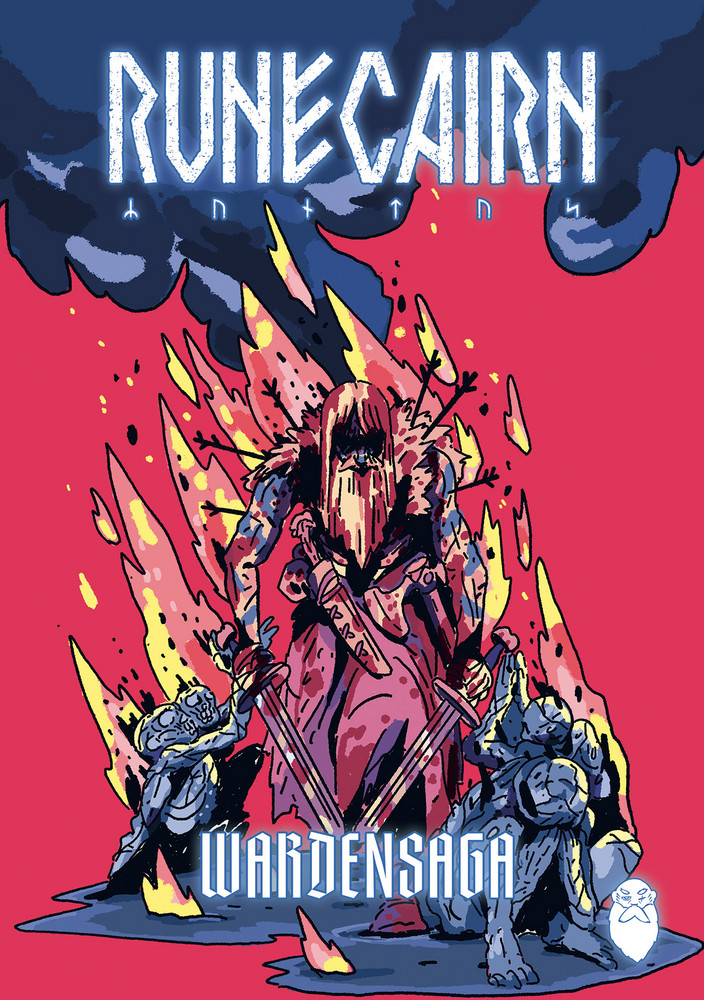
Over the last few years there have been multiple attempts to bring the Soulslike computer game to the tabletop. If you aren’t familiar with this genre of game they represent the extreme difficulty end of the challenge wedge. Giant bosses that require precise timing, great reactions, and study of their moves to defeat. It sounds like a strange thing to bring to the TTRPG sphere but there is no denying its influence. Runecairn is one of those games and it sits in the Duet style, being focused on only one GM and one player. Runecairn is designed by Colin Le Seur with art from Crom, Kim Diaz Holm, Felipe Faira & Colin Le Seur. Colin’s imprint is called By Odin’s Beard.
First Read articles represent me going through the book in question for the first time. It is my initial impressions of the mechanisms, themes, and setting presented within its pages. I have not played the game at the time of writing. I was sent the pdf of Runecairn: Wardensaga Remastered for free by the publisher.
Runecairn opens with its character sheet, an interesting choice that I am not sure about. Assuming you have knowledge of RPGs a lot of it will be familiar and definitely points towards the game being one of combat and inventory management. All the stats come first before the sheet with your character background which may give a hint at the focus this game has.
It doesn’t take long to lay out its stall in full and give a really concise but informative overview of the game. It lets you know that it is for two players straight away, goes into some of the design philosophy behind the game, and tells you the kind of adventures you can expect to play out with it. You also get the principles for the Warden (GM) and the Player laying out what they should expect from play. We also get the principles of the World, an overview of the setting which is basically summed up as the Gods are dead, the setting is Viking influenced, Bonfires show safe areas and that death is not the end. I wish more RPGs would lay out their stall so clearly. What is the harm in giving strong direction to players and GM in your game? They can always ignore it if they want, but they can’t read your mind if you don’t reveal it to them.
The art throughout the book is very evocative and feels like illustrations from an old book or the sort of thing you might find hanging on the wall of a mysterious library. It evokes a sense of place and setting without having to spell it out in explicit terms. There is good use of public domain images to reinforce a setting of ancient provenance and mystical entities. With so much brilliant art in the public domain, it is baffling that some would turn to generative AI for such a need.
Character creation is simple and quick but does come before any description of mechanisms. I know there is always fierce debate about what should come first. There are those who think that if you tell people how the mechanisms work that they will min/max their character over making an interesting person they want to play. I have bad news for those folks: minmaxers are going to do that no matter which order you put things in. For me I want some mechanical overview before I dive into character creation, especially with a game that has skills, spells, sagas (also spells) and more.


One of the more interesting aspects of these characters is that they are partially defined by a Key Item. This is one bit of equipment that bestows different skills to the character. As your game progresses you will get access to other key items that can change what your character is capable of. This really leans into the computer RPGs that Runecairn is influenced by and an idea I haven’t seen evoked so well in a TTRPG.
When you get to the system it immediately reminded me of another game I’ve been reading recently Into the Odd. Although it is going to be combat focused Runecairn has automatic hits and damage, with armour reducing damage, and saves being the point where you actually roll dice. The game also emphasises a focus on inventory management. Carry to capacity and you will take some penalties. Using certain skills and spells also gives you Fatigue each point of which takes up an inventory slot. You can get this back by resting at Bonfires or drinking certain potions. This feels like a smart way to model the loop of the Souls-like games without making something too complicated. You need space to carry the items you go searching for, and you won’t have space if you spend too much of yourself getting to the item. Especially in a duet RPG it feels like it gives the player a good puzzle to constantly occupy them.
Combat itself has some relatively straight forward choices as to what you can do on your turn, and I feel the removal of roll to hit and damage will allow the player to concentrate more on the environment of the fight and tactical options available. The game seems to be intended for theatre of the mind over minis and maps.


The second half of the book advertises itself as advanced rules. This includes two more classes that seem a bit more mechanically tricky as well as rules for making your own delves. This is a simple flow chart structure with several tables attached to give you inspiration. I started fiddling around with this myself and found it a very decent resource for getting an idea of what an adventure should look like.
Effectively you are moving around a map and working your way through monsters towards some sort of boss. The motivations for doing so, and the size of the map, can all be determined with a few rolls of the dice. The delve generator creates mysteries, conflicts, and obstacles just waiting to be overcome by the player. Considering its only a few pages of tables and a flow chart it gives some great inspiration for making delves of various sizes.
For those who are so inclined there is a set of solo rules as well as ideas for how to make the game take more players or even have a sort of adversarial player join the game (which is a feature of some soulslike computer games).
Finally the third chapter gives us a list of potential adversaries to meet on your journeys alongside an adventure to give you a flavour of the sort of adventure the game intends. This adventure “Beneath the Broken Sword” even comes with 4 pre-generated characters allowing you to just jump in and give the game a try before committing to making your own characters. The book rounds off with a nice generator for names and some personality traits of your adventurers to round them out a little more.
Runecairn: Wardensaga feels like a thoughtfully put together game. It leans into the tropes of the genre it is emulating pretty hard but I prefer my games to do that over being coy about what they are trying to achieve. It feels like the sort of game you could crack open for a couple of hours of an evening and play with vim and vigour to see how you get on in the next chapter of your characters life. I am hoping to give this one a play, as I am generally very interested in the duet design space but am yet to play any games of that type. For now you can check it out on the publishers homepage.
Thanks very much for visiting the site and reading this article. You are welcome to comment on the piece below or join our Discord. If you would like to support us financially you can do so via Patreon.

