


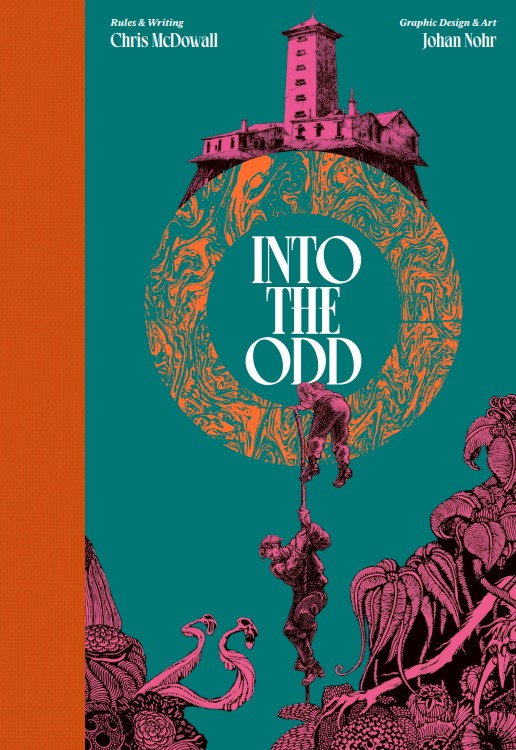
The role of mechanisms in tabletop RPGs can be a controversial subject. That is a strange thing to write, but it is true. From the origins of the hobby there have been arguments about how much GMs and players should rely on rules over just deciding what happens. For me, the rules of a game, and lets not forget they are games, should support the story the designer intended the game to tell. Sometimes when reading an RPG it is impossible to see that intent clearly. The play’s the thing.
I bought Into the Odd with my own money. I have run the game once to facilitate this review and plan to run more. There are affiliate links in this piece for Drivethrurpg.
Into the Odd, by designer Chris McDowall seems on the surface to be another rules light tribute to D&D and the way the game was played in the early days of the hobby. The characters are explorers delving into the strange areas of the world. The setting is low-magic, gritty, with a distinct horror inflection. So far, so ok. When you do actually get it to the table you realise that this isn’t rules light, it’s rules exactly enough.
McDowall has been the talk of the town after the Quinn’s Quest review of Mythic Bastionland. That game sees players taking on the role of Knights journeying across the land to take on Mythical threats. Set pre-Into the Odd, the tone is one of legends and lore. I’ve done a first read of that game and despite the different focus both show the same considered approach at their core: quick character creation, straightforward but evocative rules, and lots of help for the GM in running the game.
Characters are incredibly simply drawn. In a tribute to the original D&D, your stats are randomly generated. While I’m not a huge fan of this kind of mechanism, it means characters are very fast to create should they meet a grisly end. There is no complicated set of stats with derived skills in Into the Odd, instead we have just 3 saves: Strength, Dexterity, and Willpower.
A little Hit Protection (HP) protects your character from the outcome of combat. Finally you get a package of equipment and abilities based on your HP. These packages could give you anything from a dagger and a chain, to psychic abilities, and strange Arcanum; mystical relics that are sought after by many. .
These Arcanum are the core motivator for characters to dive into the weird underworld. They can range in scale from mysterious medallions to stupendous structures too difficult to move out of where you find them. They have weird and wonderful powers, and your reputation will swell as you bring them back to the people of Bastion, the city at the centre of the world.
This is a game that really emphasises the exploration of dungeon crawling games. It does this not through a mechanical incentive to do so, but through the way it handles that other common aspect of dungeon crawler style games: combat.


Game of this type have combat at the centre of play. Combat tends to slow down the flow of most games, as the freewheeling narrative of exploration and character interaction is replaced with initiative and turn order.
Into the Odd takes away any rolls to hit, and says ‘on your turn you just do damage’. That comes from the weapon you get in your starter package, or possibly abilities and arcanum you discover along the way. It doesn’t guarantee you will do any, as you still roll for damage and monsters can have armour or abilities that negate some. The system also defaults to the players acting first unless there is a good reason for them to be surprised.
This combination of mechanisms leads to combat being incredibly quick, and potentially brutal. Each character has only a few HP, remember that is Hit Protection not Hit Points, you feel vulnerable. Once the HP is gone, damage chips away at your strength save. When it depletes completely you are a goner. With strength saves, preventing critical hits as well this puts a real timer on your adventures in the underground. A short rest of a few minutes restores HP but if you want your saves back at full you have to be able to take some recuperation time somewhere comfortable. Basically you have to go back to Bastion.
Your 3 stats are not involved in preventing damage from combat, despite being called saves. So what are they for? When you do something that is risky, you roll saves to avoid consequences, whatever that may be. I really like the clarity of this. It makes it implicit that when you are rolling you are in danger.
With combat letting players go first and the emphasis on rolling to stop consequences, Into the Odd feels dangerous. It also puts the emphasis on trying to figure out solutions that don’t result in combat. The conversations that players and characters have lean toward trying to solve the puzzle of exploration and feel like they have mechanical heft without getting bogged down in complicated systems.
McDowall doesn’t stop with providing a light but interesting structure for exploration. Outside of your journeys into the dark of the world, there are rules for making your own business, mass combat, and even ship-to-ship battles. These are all in just 3 pages but they look solid (I haven’t had the chance to test drive these yet). There isn’t much here but it feels incredibly thoughtful. Not a word is out of place.
The GM’s section is similarly svelte at only 3 pages. It has a great core of advice: Give Info, Present Choices, and Show Impact. This feels to me like the basis of all good GMing and it is great to see it laid out and explained in such a straightforward manner.
Running the game is a breeze. The version I have of Into the Odd is from Free League Publishing (which I think is the version most of you will come across). The Iron Coral is an introductory 3 level adventure with an additional hexcrawl attached should you wish to go that far.
The layout of these dungeon sections is absolutely superb. Each room has just enough information for the GM to describe it. A wandering monster table is reported through each level, making it easy to reference. A bit of prep is required as you’ll need to get all the stats for those monsters together.
The monsters are represented by a simple stat block, much like our explorers. Sometimes they’ll have a full stat block, others just some HP. Most will also have a drive giving you a quick idea to hang any description and roleplay off. I found them extremely easy to run, giving the players room to be their characters rather than remember rules.

Towards the back of the book is a section called the Oddpendium. It includes a bunch of options for other types of character groups like Mutants, Ordinary Folk, or Unhumans (whatever they are). It also includes some excellent tables for randomly generating aspects of your world. These range from ‘What’s this street like?’ to ‘I eat the stuff’. McDowall knows what players are like, and it once again shows that they want to support play without dictating it.
Into the Odd is a game I have found delightful to run. There is not a word out of place here, with each section of the book supporting the play that Chris McDowall wants to see at the table. This Free League version of the game is beautiful but also functional, teaching the game with ease, and allowing you to run it without struggling through pages of rules and exceptions. It encourages players to explore, investigate, and puzzle and not just be murder hobos. I can’t wait to venture once more Into the Odd.
Thanks very much for visiting the site and reading this article. You are welcome to comment on the piece below or join our Discord. If you would like to support us financially you can do so via Patreon.

