

I am once more on hallowed ground. A choir of clattering dice, happy voices, and cultures colliding and coming together reverberate through this Highland Centre Cathedral. It is here that the Scottish gaming community comes together, the various denominations acknowledging the core tenet of our faith: to play is to be human. For 3 days we are reminded that games appeal to not only the hobbyist, but to the general public. Here at Tabletop Scotland 2026, we forget our troubles and simply play together.
Tabletop Scotland has grown every year since its inception in 2018. I have attended most of them, alongside many friends including Jamie Adams and Iain Chantler. Since 2023 we have taken on running the pub quiz at the event, and it is always a highlight of my gaming calendar (as I hope it is for those who attend). I spend most of the time talking to vendors, playing games, and hopefully discovering something unexpected.
I wasn’t really going hard at the press side of things this year, preferring more to absorb the atmosphere and go where the mood took me. Jamie and I made our way in with everyone else after a rousing countdown from David, the main organiser of the convention, and one of the other yellow shirts, Gemma. On entering I was immediately struck by how open the space felt, even compared to last year.


One aspect I’ve always admired in the team’s planning is how accessible the convention feels, and that starts from the moment you walk through the door. The first thing you see isn’t a wall of games, or tightly knit together stands, but large, open and colourful demo areas and folk selling some shiny dice and accessories. Even as the crowds build over the weekend the place never felt overly crowded, just nicely busy.
No matter your tastes in gaming I found vendors and events catering to it. Everything from retro styled space dwarf miniatures, to gaming related handbags were on sale from the various retailers the con had attracted. You don’t even need to be as into games as someone like myself. There was a large dedicated family zone, and an extensive games library with everything from light to the ridiculous. All are welcome here, no matter your level of experience with gaming. The organisers have always made that clear, and followed through with those intentions.
Jamie and I found ourselves over at the Hachette stand early doors to try out Chickn’Out the latest game from one of the same designers as Stomp the Plank, Benoit Turpin, a title that had been the light push your luck game of the last few years for a lot of folk. Like its predecessor this was a light game with almost toy-like production, which I mean as a compliment.


You shove tokens into a Pachinko like box, and bust if two or more of the same colour end up in the trays at the bottom. Of course the tokens mislead as to what might be on the other side of them when you choose them. If you stop then you get to take all the tokens from the last tray you dropped into and put them behind the chicken, pushing them forwards. Otherwise it is just the one. It was charming, but maybe not as much as Stomp the Plank.
As we toured around I spoke to a good few of the RPG folks exhibiting, and it was heartening to see such a wide range of styles, themes, and settings. You want a game about playing alternative versions of yourself, check out Warped from Weird Speciality Productions (which also has some odd minis to accompany it). How about some Horrible Histories style RPGs on the GMS stall from small publisher Elfling Games. If, like me, you’ve heard of Spine you could pick that up from Lost Pages sharing a stand with Hollow Press, a company making strange cards games and odd books about computer games that never were. All the weird, wonderful, and mainstream of the RPG hobby is on display here.
On the more community building side of the hobby, I spoke with folk from the Critical Chance Collective, a Glasgow based charity using story telling and role-playing to bring people together. Back in July they had put on an event called Glasgow Tales and Tabletop Gathering, a weekend of one-shots welcoming all comers no matter the level of experience. I really admire this sort of effort. Bringing people together through gaming is what the hobby is all about to me.
I also went and dropped a donation with the Independent Workers Union of Great Britain (IWGB). This massive union is taking on all sorts of corporate malfeasance and has recently turned its attention towards game studios, including Rockstar after it fired a bunch of its staff in the last year. The gaming branch of this union also has a tabletop section and that recently helped the recognition of the first TTRPG union in the UK at publisher Rowan, Rook, and Decard.
Wandering the halls of my local convention means I inevitably bump into folk that I know. We met Ben, formerly of the Unlucky Frogs who ran the quiz before us. He has become quite the talented miniature painter, and along with some friends is starting up a painting competition and event called the Iron Thistle. From the brief chat Jamie and I had with him it sounded like they were doing an amazing job getting the word out, putting on workshops, and selling out the show every time they upped the capacity. Keep an eye on this one!
For me the focus of Tabletop Scotland, and honestly most conventions I attend, will always be connecting with people be that visiting stalls or playing games. Sometimes its both.
I got to try Annulets from Eerie Idol Games, their forthcoming title that has evolved into a box set of games that all use the same components. It is meant to represent a collection of games from the Old King’s Crown universe. We played ‘Compass’ a sort of engine building game with an area control component on top. I thought it was really solid, and potentially worth the price of admission alone.

On Sunday I met up with my editor at Tabletop Gaming Magazine, Matt Chapman. He was just starting a game of Final Titan. This is a character battling game from Richard Garfield, a description that might sound very familiar if you have ever played King of Tokyo. Final Titan definitely feels very close to King of Tokyo, but has enough to feel different. You draft a stable of fighters, and then take turns deciding to enter the ring, or chuck in an upgrade card to stave off that choice. When a fighter does enter, the player picks up those cards, enabling them to better enhance the combatant they send in. Fights are simple, with just a single die rolled, triggering damage, powerups, and more depending on the fighter. Despite the random elements, even more so than King of Tokyo, it felt like a tight game where anyone could have won as we approached the final round.


One of the only games I’d committed to before the convention was playing Hubworld Aidalon, with Paul Grogan from Gaming Rules! I have been intrigued by this one for a while as it is from some of the same team that made the Fantasy Flight Games version of Netrunner, a game I deeply love. It’s from the publisher Earthborne Games, and they have admitted that this is basically their take on Netrunner. Considering Null Signal are doing a great job keeping that game alive, I was intrigued as to what this would feel like.
Paul is an excellent teacher and my familiarity with Netrunner made Hubworld easy to pick up. In a similar manner to its inspiration, you are diving into deck, hand, and discard in order to score Agents, 3 of which win you the game. Unlike Netrunner there is no asymmetry here, you are protecting your agents while simultaneously trying to get at your opponents. The Agents are very powerful cards, and can be played into the 3×3 grid that protects your hand discard, and deck. Of course they are vulnerable there, but most cards have a built in cost for encountering them.
As you put your grid together your opponent has to find ways through, paying the cost to get past certain cards if they are face up, or choosing to encounter face down ones if they think it is worth their time. There is even a built in way to get more card accesses when you do get through the grid, something that was only on cards in Netrunner. The game felt very much like the economic battle of Netrunner but with enough little tweaks to make it feel different and, to some extent, smoother. It has definitely peaked my interest in the final release. Paul was kind enough to give me the demo decks so I’ll be giving those a bit more of a shake soon.

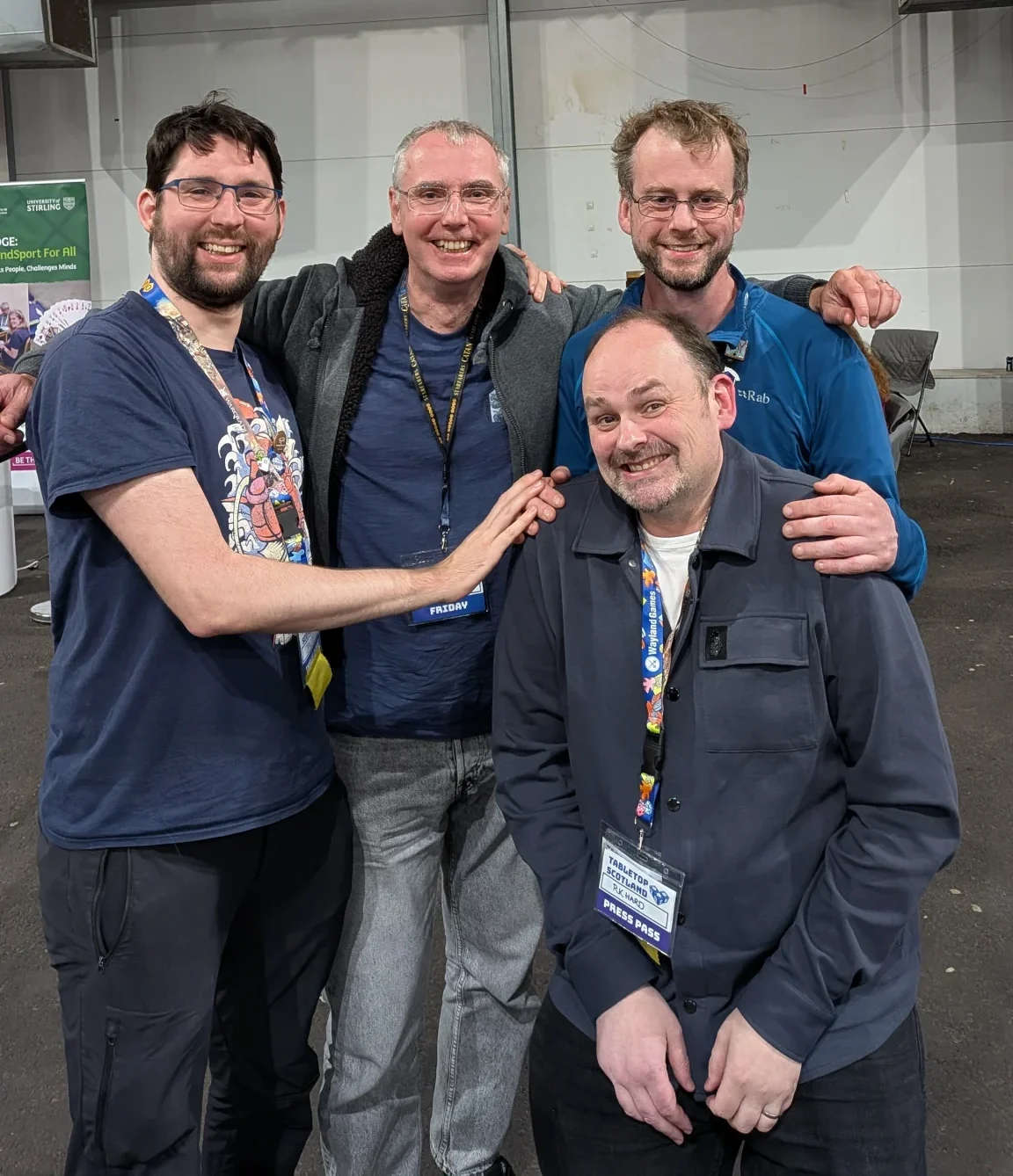
On the Friday Oliver Kinne and his wife joined us very briefly before they headed out on the North Coast 500. We took the opportunity to get a quick team photo of the last Brainwaves team. It was the first time Jamie and Oliver had met in real life!
We also met up with Richard from We’re Not Wizards and Isa and Scott who used to run Tabletop Cafe, one of the first truly nice games venues in Edinburgh that is sadly no longer with us. They had brought Sky, Isa’s nibling, for their first gaming convention ever! I took them through some Magical Athlete and Barbecubes, and I am reliably informed that Sky had a great day out. They have just started getting into dungeons & dragons so I am sure plenty of shiny maths rocks and various other gaming peripherals were purchased over the course of the day!
Over the course of the convention I played Micro-Macro, Courtisans, Cat and the Tower, Frozen Passage (bad rulebook, interesting game), Spokes, Compile, Barbecues, and Viking See-Saw on top of the games I’ve already mentioned. Special shoutout to Phil Harris who runs the Game Jam section of the con who showed us one of the prototypes called 3-Letter Problem. This game had a slightly intimidating looking word sheet with it, but was actually really enjoyable.
Each player has a hand of cards, each of which has a letter and a value on them. The values range from 1-3 and you start with 4 of the 3 value letters. A three letter word is formed in the middle of the table. On your turn you’ll play a card onto that word, to form a new 3-letter word. If you play a 3 point card then you capture all the cards in that pile. Person with the most points at the end wins. The intimidating looking sheet is a list of all the words that you could possible play. I had fun playing it, and it is always nice to turn my critical brain towards giving developmental feedback.


Of course the highlight of Tabletop Scotland every year is running the pub quiz with Jamie. We have a wonderful team that help put this on every year, and this time it consisted of Iain Chantler, former Brainwaves co-host and friend, and my wife Catherine Dolliver on scores, and long time friend and gaming buddy Iain Galloway providing our audio. This year’s quiz was easily our best yet, aided by a mysterious bug round, and a new section we put in that had us going out with a bang. For the first time we had to use our tie break! Thanks to everyone who attended, and especially the Sleepy Sparrow crew for sprinkling in some chaos.

Tabletop Scotland really is one of my favourite conventions ever. It has a welcoming atmosphere, considers the needs of its various attendees without judgement, and highlights the sheer diversity and inclusivity that you can find in Tabletop Games. I am sure we will be back next year, and I hope I’ll play some games with some of the folk reading this. Maybe you’ll come along to the quiz, and see us in our element. Whatever your reason for attending, I think you will find something to love at Tabletop Scotland.
Thanks very much for visiting the site and reading this article. You are welcome to comment on the piece below or join our Discord. If you would like to support us financially you can do so via Patreon.

