


I’ve played games all my life. One of my earliest gaming memories is playing pairs on the floor of my family home with my parents. A version of the game that came in a beaten up blue box, from Waddingtons or a company of that ilk. Simple, satisfying, comforting. Educational in a way I would expect. I think there might have been a pair of pears. Irony? I don’t know.
From these early days I was always wanting to play games. A cupboard in the corner of my parents living room was a games repository, alongside a good couple of boxes of lego. The usual fair in a family home in the 80s and 90s was within: Monopoly, Jenga, Scrabble and more. My parents held regular game nights where they played Mah Jong, well a westernised version of the game.
When I was old enough I was allowed to join this gathering. I was taken with the feel of the pieces, the strange symbols, and the satisfying clack of tiles as they were shuffled, stacked, and played. More than anything I was aware Mah Jong was a game from another culture, filtered through ours. I’d been playing chess with my Dad but here was something from a different time and place. I realised that games existed everywhere.


At the time, this was especially true in Germany. I was fortunate that my father had a penpal in that most hallowed of gaming towns, Ravensburger. Through this connection I was exposed to the world of German game design. A Spiel des Jahres title or two found its way into our collection long before I knew what that meant. Games like Goldgrabber, Sagaland (Enchanted Forest), and Scotland Yard saw frequent play at our table.
I was a voracious reader and this led to my discovery of Fighting Fantasy books. These were a series of “Choose Your Own Adventure” books written by Steve Jackson (the British one) and Ian Livingstone. These led to Advanced Fighting Fantasy and my first foray into Tabletop RPGs. Some very tolerant friends let me run a game for them with not great success. Having little access to RPG shops in the Highlands of the mid 90s, that particular section of the hobby wouldn’t really open up for me until University.
I attended Edinburgh University to study Physics, I currently work in a Brewery which goes to show you never really know where you will end up. But I digress. Uni gave me a strong friends group that I still know to this day and opened up gaming for me as a major part of my life. It started with a trip to the then only dedicated games shop in town Black Lion Games. This was my first exposure to the variety of gaming on offer even back then and I was hooked. These were the heady days of the CCG boom in the late 90s, the rise of eurogames as Catan made its way into everyone’s home, and the slow emergence of The Forge and story games.


We are getting a little ahead of ourselves in my own personal journey and this ramble down memory lane. Doomtown was the game that really unlocked the wider scene for me. I loved this Weird West themed CCG, full of cowboys, monsters, and mysterious agencies. The RPG Deadlands was built around the same universe, and I ran a lot of it. Was it good? No. Should you play the newer version powered by Savage Worlds? Yes. Nostalgia has me looking at the original game through rose tinted glasses, but I think if I played it today, I would bounce straight off it. Our tastes change, we move on, grow, and evolve.
I would run a variety of RPGs over my time at University: 7th Sea, Warhammer Fantasy Roleplay, playtested some Spyfall during the d20 boom, and even dabbled with my own designs. I found joy in entertaining around my table and this period established a group that is still going to this day, albeit with a few changes in the makeup. Theseus’ games group.
Along the way I established a board and card game club called FAQ at the University that is still going, but under a less pretentious name. Although I would not come to embrace it until much later in life, this period gave me the first hints that I was ‘cursed with the organisational spirit’ to quote myself on ‘But, Why Vikings?’.
Some of the games I bought during this period became foundational texts for me and would be a cornerstone of the way I look at, and think, about games. King of Tokyo, Lords of Vegas, and a variety of Cheapass Games introduced me to more thematic designs, and formed a strong love of themes being supported by mechanisms. I still hold that idea close to my heart, and celebrate it whenever I find it.


Post-Uni I fell into helping out a bit with a local RPG company called Contested Ground Studios as they released a|state. It was a transitional time for me over those first few years as I went to work for HMV, having not covered myself in glory at University, dabbled with design, and tried to figure out what I really wanted from my gaming life. I wrote a bit for a|state, not very well. I even ended up designing an RPG called Mob Justice that Contested Ground put out (also not very good). I’ll always be grateful to Malcom, Gregor, Paul, and the rest of the team for the experience. More influential than this was my contact with The Forge and The Collective Endeavour.
The Forge was a forum established by now famous, or infamous depending on your perspective, RPG designer Ron Edwards. It was an incredibly influential space attracting all sorts of designers, and establishing new ideas around RPG theory and design. Apocalypse Worlds is the most influential game to come out of this place, but certainly not the only game with a long shadow. I played many strange and interesting games in that time, long before I would turn my attention towards critiquing RPGs. It gave me a base of experiences from which to begin that journey, something that has been increasingly useful as I’ve turned my attention towards RPG criticism as a focus in the last couple of years. I’ll rarely say ‘you must play game x to be a critic’ but I do believe you must play widely. Context is king.
The Collective Endeavour was a group of UK RPG designers that decided to split the cost of a stall at conventions and help each other out with production, design, and all the logistics that go into taking a game from concept to product. Although I am not as close to them as I was at the time, I made friends in that period that last to this day. Some of that group are still producing games from time to time, most notably through Handiwork Games, a Scottish studio that has been reviving a|state, Cold City, and Hot War. I gained a load of experience running demos, a stall, and learning how to interact with folk at a convention in different contexts. I even produced my own little card game through Print On Demand and the now infamous Ken Whitman. You can still buy “Revenge of the B-Movie” on Drivethrucards to this day. The Collective Endeavour is an oft forgotten part of UK gaming history, but its influence runs deep through the current RPG culture.
I don’t fully recall when the Collective Endeavour wound up, but I had already started to drift away from designing games. Over those years I had helped run playtest groups, dabbled in design, done some pitching, but eventually I realised a truth: I enjoyed talking and writing about games more than designing them.
I started doing just that. It started simply, reviewing the games in my collection, talking about Netrunner decks as I made my way through the competitive scene. We all have to start somewhere. I don’t think I’ve ever wanted to write full-time about games. To me that feels too much like turning a pastime into a job. I did have a long term ambition to make a little money from writing, to legitimise my art through cash. A naive attitude I’ll admit, but this ramble is about the journey.
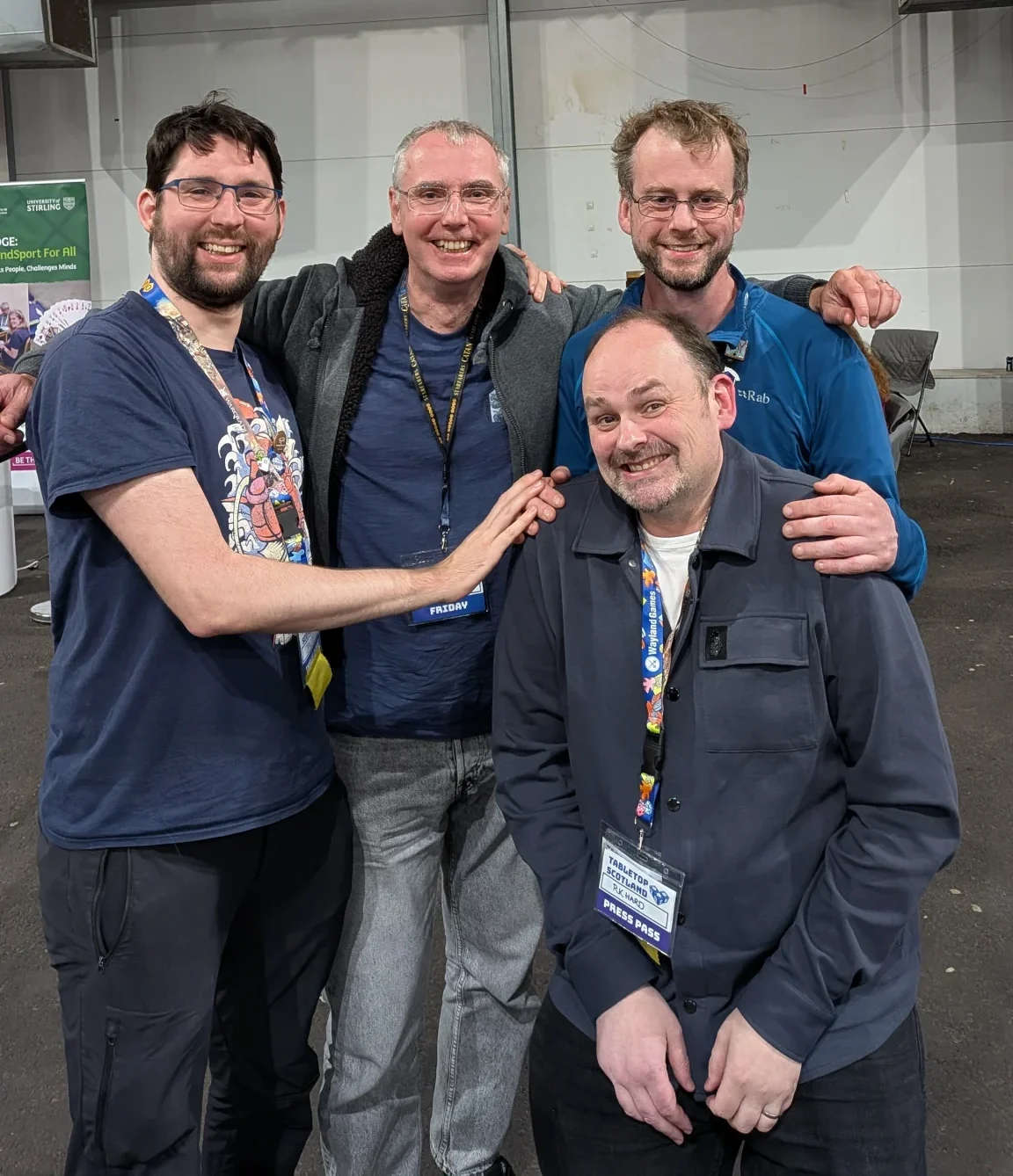
I had always been a keen convention attendee, but now I had a way into the inner sanctum of the press event. One of the heartening things about a hobby like ours is how generous people are with their time and access. I’ve always been one of the smaller sites in terms of social media reach, but events like UK Games Expo would happily give me a media pass. I’ve interviewed multiple folk in the industry over the years, all who have been more than generous with their time and patience.


(now of Polyhedron Collider)
I always was, and still am, awkward about trying to get review copies. When I started out on my critical journey I needed that access as I just didn’t have the personal capital to buy all the games I wanted to review. I came up as a critic in a time when tabletop gaming was booming: conventions breaking records year on year, the explosion of RPGs brought on by 5th edition and Critical Role, and more studios than ever producing the weird and wonderful. We live through the repercussions of that boom even now, arguably it is still happening. All we can do is ride the shockwave into a future that seems bright, unpredictable, and increasingly diverse.
I’ve been enjoying exploring the present state of RPGs, and thinking about their future. Over the last couple of years I have changed what I cover and how I cover it. I write when I want to and that has led to the work being better (well I hope it is at least). I’m in a position now to just buy games I want to look at, which I feel helps support the creators whether or not I end up covering it on the site or through any other outlet. A focus on RPGs has led to my columns in TTGM, talking to people from all over the world about their games, and a chance to play what I feel are some of the best tabletop games out there. I still love board and card games, but I really do think that RPGs are where the secret tabletop sauce is at the moment.
I started writing this piece on my birthday, September 13th, but a bunch of life admin threw my month into a tailspin. It’s easy to put too much pressure on yourself as a creative, to feel that you aren’t putting out enough, not giving your audience what they want. Real life and your relationships with friends and family have to come first. I do say that from a position of privilege, where I don’t need to write for a living, it would be wrong not to recognise that. I still believe though, that even if you do need to create for your income, you need to find ways to be kind to yourself, to be able to take a moment here and there for your mental health.


I don’t know what the future holds for me and the hobby I love. Tabletop gaming is in a moment when it is increasingly ‘mainstream’. That brings with it the benefits of wider attention, and the risks of homogenisation. I genuinely believe that bringing more people into the hobby as players, designers, and critics is good for the culture at large. Diverse perspectives, bring us diverse games, full of ideas we haven’t come across. Some of these will delight, others will disappoint, but all of them are an expression of someone’s desire to make something that is an interactive piece of art. That is an amazing commitment.
Games can be so many things. They can bring us joy, scare us, make us reflect on moments both imagined and real, make us laugh, cry, celebrate, and remonstrate. They are as diverse as humans are, an expression of hopes, desires, and fears from different cultures and philosophies. I hope in my continued journey through this weird and wonderful hobby to help you find the games that you will love and cherish. Doing so has changed me in ways I can’t articulate, helped me make friends I’ve had for decades, and brought amazing people into my life. My life will inevitably change, but I will always be a player of games.
Love you all.