


I’ve never really been one for running pre-written adventures. Actually that’s not true, it is kind of where I started. I think it is where a lot of folk start when they decide to run RPGs, and certainly it was my route into the hobby as I took some friends through the adventure in Advanced Fighting Fantasy way back in my school days. Since then I’ve had a swing at Warhammer Fantasy Roleplay’s Enemy Within campaign and even made a good dent in The Great Pendragon campaign. These are epic, years long efforts, even if you don’t finish them.
My interests have shifted away from running such games, towards the more improvisational, but structured, comforts of games like Blades in the Dark, Agon, and Slugblaster. These self contained games don’t require pre-written adventures, or even much in the way of supplements. That doesn’t mean those parts of the hobby are totally off my radar. I try to keep an open mind as much as possible.
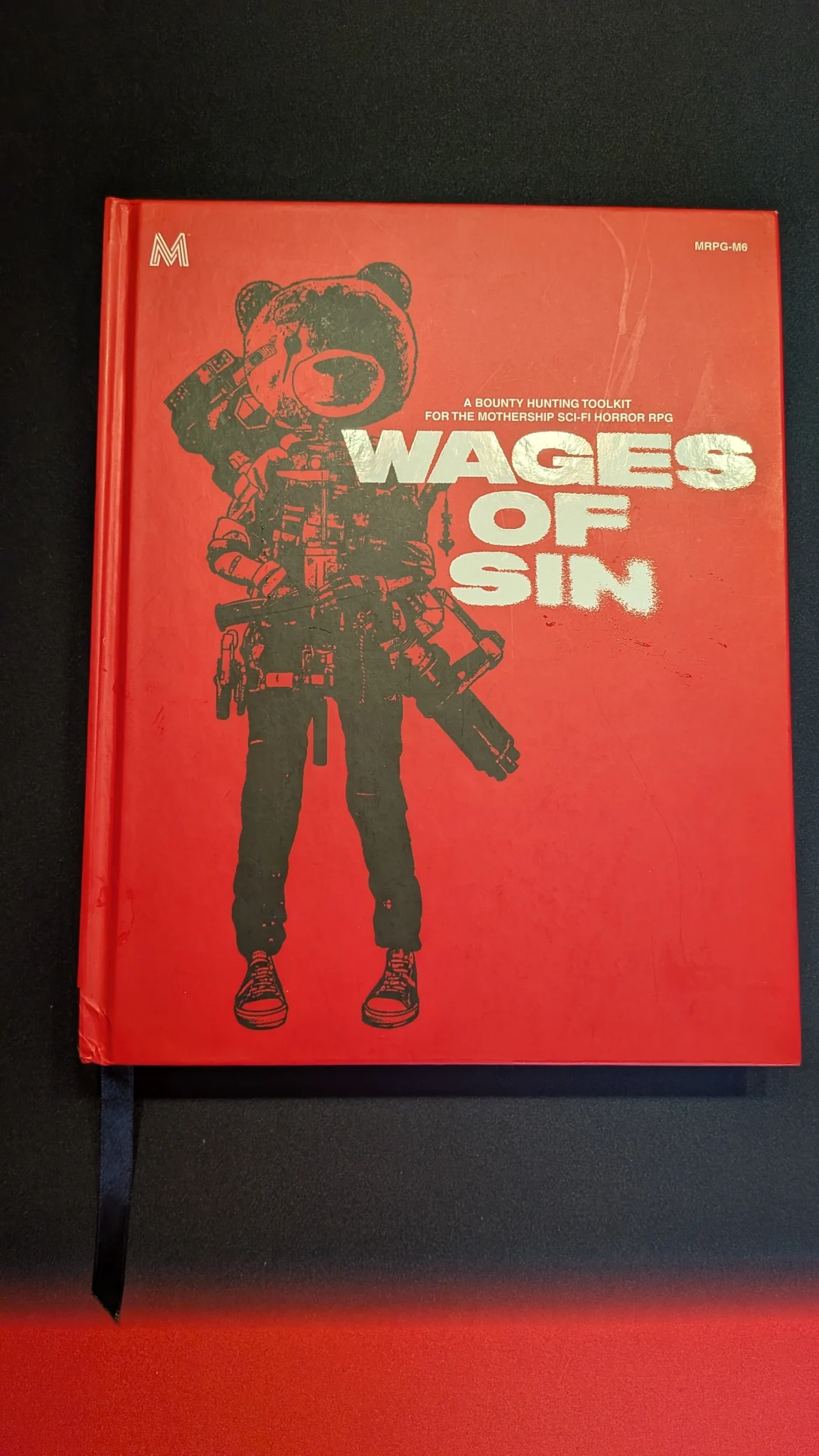
Recently I reviewed Fatherfog for Tabletop Gaming Magazine in the UK. The publisher Tuesday Knight Games sent me a copy of Wages of Sin, a ‘bounty hunter toolkit for the Mothership sci-fi horror RPG’. I wasn’t even sure I was going to write about it, but then I started flicking through it and I tell you what, this makes me want to take another shot at running Mothership. Wages of Sin is written by Luke Gearing and Alan Gerding, edited by Jarrett Crader, with graphic design from Adam P. McIver and Sean McCoy. The art comes from Tyler Garlands, Gil Rodrigo, and Adam P. McIver.
I received Wages of Sin, a regular edition and a deluxe edition, alongside Megadamage from Tuesday Knight Games with no expectation of coverage.
Shortly after Mothership was making a lot of noise back in 2019, picking up multiple Ennie awards, I ran the early, free version of the game. I didn’t really get on with it at all, finding it lacking in the more structured play I had come to enjoy from Blades in the Dark and its ilk. I was running it online during the pandemic for a fairly large group, I prefer smaller tables, which probably coloured the experience for me. I left the fans to it, confused by the plaudits for what I considered an unfinished game at the time.
Since then I have dabbled more with the OSR style of RPG, harkening back to the early days of the hobby. Mothership definitely sits in this category alongside the excellent Into the Odd, which I wrapped up a campaign of recently. I have no idea if I’ll end up liking Mothership this time around but I have picked up the core box to give it a fair shake.


That’s a bit of a long winded way to get to the core of this article, but context is king when it comes to understanding RPG criticism. You know I haven’t used the book as yet, so this is a Skim Read, but I am familiar with the source in a GM capacity. With that in mind lets take a look at Wages of Sin.
Mothership is a game that has been almost fanatically supported by its community. There are zines a plenty, adventures, supplements, and more besides all designed to work with the game. Is Wages of Sin a supplement, or an adventure, or a campaign? It’s all of these and more.
The first thing that strikes you about Wages of Sin, other than its fantastic production values, is how incredibly user friendly it is from the very first pages. It kicks off with multiple ways to use the book: one shots, campaigns, or just as side gigs in your main campaign. It even goes as far to point you towards which of its one hundred bounties to use for one shots, including the very first one in the book which feels like a very deliberate bit of design. It also gives you some guidance on the type of campaigns you could run using just Wages of Sin,
Wages of Sin wastes little time in getting to the bounties themselves. These come in 9 levels as the stakes get higher and higher and the targets more dangerous. A fantastic chart right at the start of the book lays out where each bounty sits on this scale, making it simple to go and check out the type of mission you want.

Before it gets to the bounties proper, it pulls one last organisational aid out of the hat. Listing the various locations bounties can be collected in alphabetical order, the level of those bounties and a few words describing their theme. For instance the first bounty in the books is also the first one in this list. It is at Absalom Station, Bounty Level 1, and is a monster/conspiracy bounty. This allows a GM, Warden in Mothership, to have a quick scan of themes, or go by location to get just the scenario you want. All these locations relate to the map tucked into the back of the book, which details the Anvolla cluster.
The map once again demonstrates the consideration the writers and graphic designers have given to useability. Every planet, station, and cluster has a page reference and fuel costs and similar lifestyle needs are summarised down the side. This precise attention to detail permeates Wages of Sin, a book that isn’t afraid to repeat information where it will be useful.


I don’t want to spoil all the cool bounties in this book, but let’s look at the very first one to give you an idea of what you’ll be getting. Ianeria Grimm is a debtor on Absalom Station. You get an overview of the station, which features the intriguing “Temple of the Merciful Lord’ detail that feels ripe for some interesting narrative.
The bounty itself starts off with the advert the players would likely see on a bulletin board. It then dives into an overview of the location and the target, with nice splashes of colour that help paint the picture of them as a person not just a job for the players. One the right of the page you get a portrait and details of their Bounty Leve, crime, how they are wanted (alive dead, etc.), who the client is, the reward, if there is a bonus tobe had, and any known associates.

As you might expect, Warden information takes up a large chunk of the bounty, giving you all the details you need to run this adventure. This is straight to the point, detailing the nature of the target and their potential transformation into a monster. Mechanical details relating to the systems Mothership reside mostly in footnotes, making this sourcebook feel easily adaptable into your sci-fi game of choice. The details given even go so far as to outline the consequences of failing the job.
The level of those details is precise enough to hold the job in your head, without bogging you down with so much detail you can’t see room to improvise and make the bounty your own. For instance ‘The Watchers’ mentioned in the Ianeria Grimm bounty, want to have this experiment come to pass, but there are no details of precisely who they are. A spark to hang your ideas off. This generosity with gameable detail permeates every job.
What a list of jobs it is! From tracking petty thieves to taking on strange cults, and bringing rogue AIs to heel, the variety of the bounties is immense. The Mothership community is famous for its support for the system, making zines and modules in their hundreds. Each of the bounties here feels like one of the small zine modules the game is famous for, with maybe not quite the same level of detail.
When you get to the end of the one hundred bounties within Wages of Sin, you realise that this isn’t just a book about tracking targets for cash, but also about being hunted. Ten famous bounty hunters are listed, along with their loadouts and a bit about how they operate and some Warden advice on how to run them. When the characters attract the ire of some organisations, you now have a stable of colourful characters to throw after them.
But wait, there’s more! If one of these bounty hunters, or the local law enforcement catch up with your characters, there is a prison waiting for you in the last section of the book: The Offender Detention Center (ODC).

This section contains a prison layout, with details of blocks, security measures, and potential escape routes. It covers rules both the institution and your fellow inmates impose upon you while incarcerated. On top of the one hundred bounties listed as the main section of the book, there are details of the staff and one hundred prisoners you might encounter. There’s even detailed plans of the surrounding area and the various creatures that could cause you some issues as you try to escape. All this information is summarised again in the indexes, splitting the prisoners you can encounter down into their cell blocks. It is just another nice usability consideration.
Wages of Sin has genuinely surprised me. Its an incredibly well put together book and very generous in scope for the £50 or so it will set you back. There are potentially years of gameable material in here, or maybe you’ll just find the perfect one shot to give Mothership go. It is so good it made me buy the Mothership core set just to get to have the chance to run it. The writing is evocative and detailed, without being fussy and bloated. The editing and graphic design are top class and make the books usability one of the best I’ve seen. It is one of the most compelling supplements I’ve seen in a while and surely destined to go down as a classic.

Thanks very much for visiting the site and reading this article. You are welcome to comment on the piece below or join our Discord. If you would like to support us financially you can do so via Patreon.

